
2026 Industrial Automation Trends: Physical AI, Humanoids & Safety
AutoControl GlobalAutoControl Global July 28, 2026Navigating the Mid-2026 Shift in Industrial Automation: AI Picking, Humanoids, and the New Safety Benchmark
The industrial automation sector is experiencing a massive transformation in mid-2026. Technologies are quickly moving from experimental trade show demonstrations directly onto factory and warehouse floors. Operations and procurement teams face an increasingly demanding evaluation environment. They must navigate a wave of software-defined robotics, complex multi-arm humanoids, and stringent new safety requirements. This shift fundamentally alters how facilities select vendors and scale their control systems.
Software-Defined Grippers Transform High-Volume Factory Automation
For decades, mixed-SKU logistics required expensive, custom mechanical grippers to handle diverse products. Festo is changing this dynamic with its GripperAI system, which relies on simulation software rather than bespoke hardware configurations. This software-defined approach targets the traditional friction points of object recognition and grasp planning in factory automation.
At the Automate 2026 exhibition in Chicago, physical AI emerged as a dominant operational theme. Leading vendors like Dexterity, NEURA Robotics, and Doosan Robotics all unveiled AI-integrated platforms built for rugged warehouse environments. Furthermore, logistics pioneers Ambi Robotics and Pickle Robot recently integrated their technologies to unify truck unloading and palletizing into a single inbound workflow. Consequently, these integrated physical AI systems are compressing what used to be year-long deployment timelines into just a few months.
Multi-Arm Humanoids Adopt Standard Control Systems Infrastructure
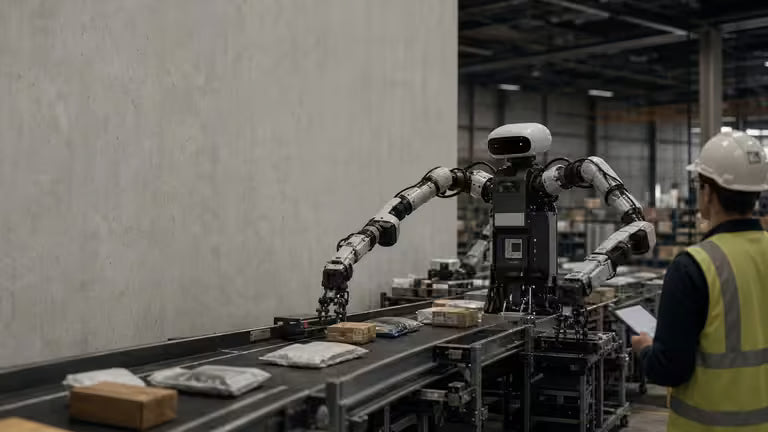
Novel robot form factors often introduce significant integration risks for plant engineers. However, Dexterity is mitigating this issue by building its "superhumanoid" Mech robot on Beckhoff Automation’s EtherCAT communication protocol and TwinCAT controller platform. EtherCAT delivers the deterministic, real-time performance that controls teams already trust and manage daily.
Dexterity also expanded its alliance with Kawasaki Robotics by pairing the Mech platform with the industrial-grade RL030N arm. For global operations leaders, this architecture provides a massive advantage. Engineering teams can deploy advanced multi-arm humanoids without learning entirely new fieldbus tools or support software. This familiarity drastically lowers implementation friction across distributed DCS (Distributed Control System) networks.
Strict Safety Certifications Raise the Bar for Automation Procurement
Information security and physical safety are no longer optional line items in industrial procurement. Yaskawa recently secured the global ISO/IEC 27001:2022 certification for its information security management systems. As IT and OT (Operational Technology) continue to converge, a vendor's 27001 status serves as a critical qualification criterion for critical-infrastructure projects.
On the physical safety side, Sonair introduced the ADAR One, the first safety-certified 3D ultrasonic sensor designed specifically for human-robot collaboration. The sensor achieved vital SIL 2 and Performance Level d ratings, offering an excellent alternative to optical systems. Traditional laser scanners frequently fail in harsh environments where dust, intense glare, or physical occlusion disrupt vision. Therefore, compliance leads evaluating automation suppliers must demand explicit compliance roadmaps rather than accepting vague marketing promises.
Intralogistics Consolidation and No-Code Cobots Simplify Plant Integration
Market consolidation and simplified programming are lowering the barrier to entry for specialized manufacturing processes. Comau recently acquired Invent Smart Intralogistics Solutions to expand its automated material handling footprint into South America. This acquisition offers global manufacturers seamless local support for complex intralogistics rollouts across expanding regional markets.
Simultaneously, Hirebotics launched its Cobot Painter, an explosion-proof, no-code collaborative robot designed for hazardous finishing environments. This system eliminates the need for expensive, dedicated paint cells or highly specialized robotics programmers on staff. Additionally, recent data from RoboDK indicates that its latest CAM software reduces robotic machining deployment times by 40 percent. These measurable advancements allow plant managers to calculate clear ROI metrics for their next budget cycle.
Technical Insights: The Author's Perspective
From an automation engineering standpoint, the mid-2026 landscape proves that software maturity is outpacing hardware customization. The reliance on established fieldbuses like EtherCAT for humanoid control indicates that the industry values reliability over proprietary novelty.
Furthermore, the rise of ISO 27001 in manufacturing highlights the growing vulnerability of connected PLC and DCS networks. Procurement teams should no longer view safety and cybersecurity certifications as mere paperwork. Instead, they represent essential defenses against operational downtime. Integrators should prioritize modular, software-driven assets that seamlessly link with existing plant architectures.
Practical Application: High-Volume Inbound Fulfillment Scenario
To understand how these technologies converge, consider a modern retail distribution center managing high-volume inbound logistics:
- The Challenge: Incoming freight containers arrive with unpredictable, mixed-SKU pallets containing everything from heavy electronics to fragile consumer goods.
- The Solution: An integrated physical AI cell uses a multi-arm humanoid robot configured with software-defined grippers. The system runs on a centralized Beckhoff TwinCAT controller linked via EtherCAT.
- The Safety Layer: Safety-certified 3D ultrasonic sensors monitor the perimeter. They allow human workers to enter the zone to clear plastic wrapping without halting the entire line.
- The Result: The facility processes mixed pallets continuously without changing hardware. Meanwhile, the ISO 27001-certified architecture ensures that the data exchange between the warehouse management software and the physical PLC remains completely secure against cyber threats.