
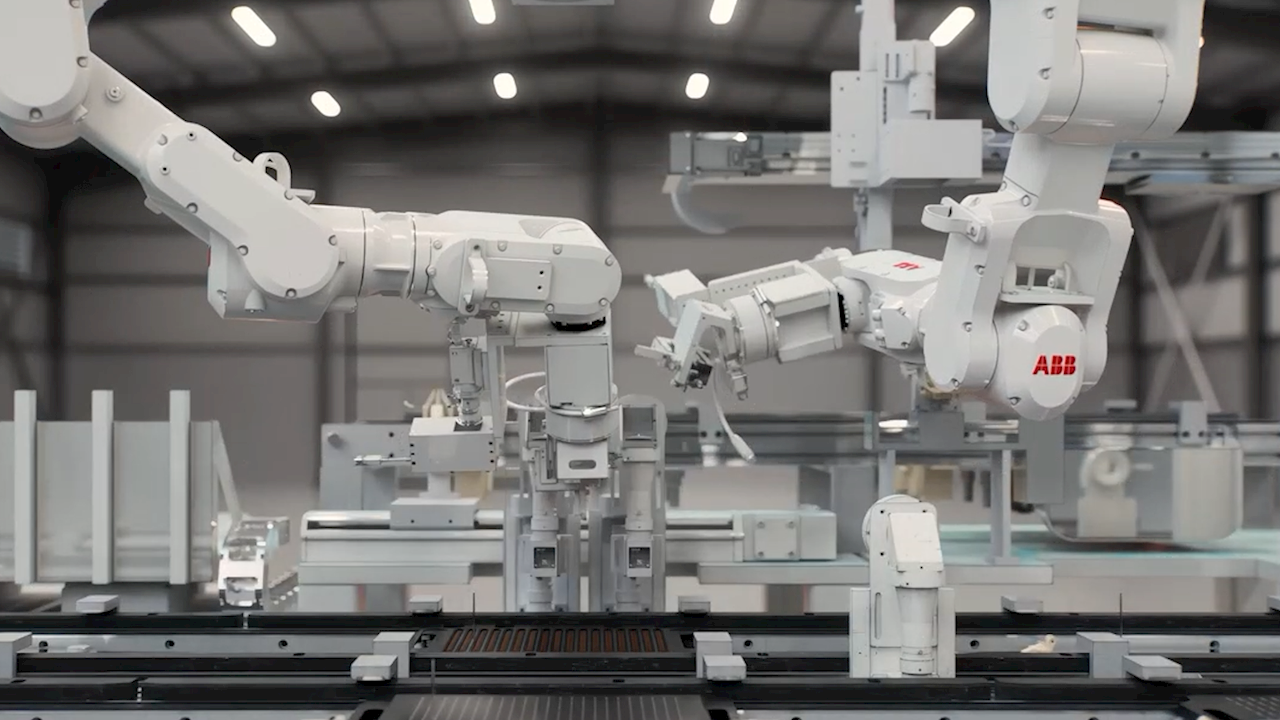
ABB and NVIDIA Partner to Revolutionize Factory Automation with AI
AutoControl GlobalAutoControl Global June 05, 2026ABB and NVIDIA Partner to Revolutionize Factory Automation with Physical AI
The industrial automation landscape is undergoing a massive shift as virtual simulation and real-world deployment finally merge. ABB Robotics has announced a strategic partnership with NVIDIA to integrate NVIDIA Omniverse libraries into ABB’s signature RobotStudio software. This collaboration aims to deliver industrial-grade physical AI at scale. By launching RobotStudio HyperReality in late 2026, the companies plan to eliminate the traditional boundaries of factory automation testing. Consequently, manufacturers can expect to see dramatic reductions in commissioning costs and significantly faster times-to-market.
Bridging the Sim-to-Real Gap in Digital Twin Technology
For decades, automation engineers have struggled with the "sim-to-real" gap. This term describes the mismatch between virtual simulation environments and actual factory floors regarding lighting, textures, and physical tolerances. This discrepancy frequently forced engineers to spend weeks debugging physical hardware after initial virtual testing.
ABB solves this problem by combining NVIDIA's accelerated computing with its own proprietary virtual controller firmware. Because the virtual controller runs the exact same code as the physical robot, simulation correlation reaches an unprecedented 99% accuracy. Furthermore, ABB integrates its Absolute Accuracy technology into this ecosystem. This combination reduces positioning errors from a standard 8–15 mm down to a precise 0.5 mm, ensuring that high-precision control systems perform identically in both virtual and physical spaces.
Streamlining High-Precision Consumer Electronics Assembly
The practical benefits of this physical AI platform are already evident in high-stakes manufacturing environments. Foxconn, the world’s largest electronics contract manufacturer, is currently piloting the technology in its consumer electronics assembly lines.
Automating the assembly of minute components presents severe challenges due to delicate metal structures and frequent product variations. Traditionally, changing a production line required extensive physical prototyping and manual fine-tuning. By utilizing RobotStudio HyperReality, Foxconn engineers generate hyper-realistic synthetic data to train assembly robots virtually. As a result, the team optimizes production lines before physical hardware even arrives, cutting setup times and accelerating the product evolution cycle.
Mitigating Labor Shortages for Small and Medium Enterprises
While large enterprises like Foxconn leverage this technology for precision, small and medium-sized manufacturers are utilizing it to combat ongoing labor shortages. WORKR, a California-based robotic workforce company, is bringing these advanced AI models directly to smaller factory floors across the United States.
WORKR combines ABB's industrial hardware with its own WorkrCore™ AI platform, trained entirely on synthetic data generated via NVIDIA Omniverse. This approach allows factory operators to deploy intelligent robots without any traditional programming knowledge. Operators can teach robots new tasks in minutes, making advanced factory automation accessible to businesses that previously lacked the capital or specialized engineering staff to implement robotics.
Future Horizon: Real-Time Edge AI Inference with OmniCore
Looking beyond simulation, ABB is actively evaluating the integration of the NVIDIA Jetson edge computing platform into its next-generation OmniCore controllers. This integration will bring real-time AI inference directly to the factory floor.
Instead of relying on cloud networks, industrial robots will process complex visual and spatial data locally. This architecture ensures ultra-low latency and robust data security, both of which are critical for modern distributed control systems (DCS). This edge-AI evolution builds upon ABB’s existing portfolio, which already utilizes NVIDIA Jetson for visual simultaneous localization and mapping (VSLAM) in its autonomous mobile robots.
Author Insight: A Paradigm Shift for System Integrators
From an industry perspective, this partnership represents a fundamental shift in how system integrators and automation engineers will approach factory design. Historically, simulation software served primarily as a visual sales tool or a basic path-checking utility rather than a definitive deployment mechanism.
By achieving 99% simulation accuracy, ABB and NVIDIA are turning the digital twin into a reliable source of truth. The ability to generate high-fidelity synthetic data means physical AI models can learn to navigate complex environments, variable lighting, and unpredictable materials entirely in the cloud. This capability drastically reduces financial risk for system integrators. They can now guarantee performance metrics to end-users before purchasing a single piece of physical hardware. This predictability will likely accelerate the adoption of robotics in sectors that have traditionally resisted automation due to high upfront engineering costs.
Industrial Solution Scenario: High-Mix, Low-Volume Automotive Component Manufacturing
To understand how this technology functions in a live industrial environment, consider the following deployment scenario for a tier-one automotive supplier handling high-mix, low-volume production.
The Challenge
A manufacturer needs to frequently reconfigure a robotic work cell to assemble diverse variants of electric vehicle (EV) battery cooling plates. Physical teaching and manual programming cause hours of downtime during every product switch, killing profitability.
The Solution Pathway
1.Virtual Cell Configuration:Phase 1: RobotStudio HyperReality。
Engineers import the 3D CAD files of the new battery plate variants into the digital twin environment.
2.Synthetic Data Generation:Phase 2: NVIDIA Omniverse Integration。
The system automatically generates thousands of hyper-realistic training scenarios, altering lighting angles, metal reflections, and surface textures.
3.AI Model Training:Phase 3: Physical AI Optimization。
The robot's neural network trains on this synthetic data inside the simulator, mastering precise pick-and-place trajectories and force-control feedback.
4.Zero-Downtime Deployment:Phase 4: Real-World Execution。
The validated AI model is flashed directly to the physical ABB OmniCore controller. The physical robot achieves 99% accuracy on the first run without manual programming.