
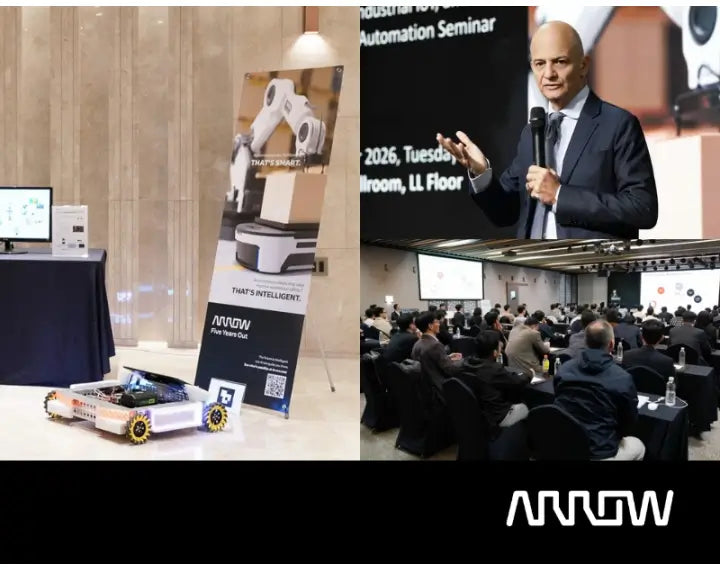
Arrow Electronics Hosts Industrial Automation Seminar in Seoul
AutoControl GlobalAutoControl Global October 20, 2026Driving Next-Gen Smart Manufacturing: Key Insights from Arrow Electronics' Seoul Tech Seminar
Accelerating Factory Automation with Advanced Embedded Technologies
Arrow Electronics hosted an impactful technical seminar in Seoul today, focusing on the rapid evolution of smart manufacturing. The event showcased how modern industrial automation relies heavily on cutting-edge components, sensors, and microcontrollers. Leading semiconductor providers joined forces to present integrated solutions designed for high-performance control systems, programmable logic controllers (PLCs), and distributed control systems (DCS). Engineers now have direct access to robust ecosystems that streamline complex architecture design and accelerate time-to-market.
Uniting Global Semiconductor Leaders to Solve Complex Design Challenges
Key component suppliers like Infineon, Lattice Semiconductor, STMicroelectronics, and Silicon Labs presented their latest hardware innovations. Furthermore, high-performance power and connection experts such as Vicor, Samtec, and Yageo Group introduced specialized interconnect and power delivery units. These global technology partners addressed critical pain points in sensor-to-cloud integration and precise motor control. Collaborative ecosystems like this allow development teams to easily resolve compatibility issues across disparate fieldbus networks and industrial ethernet protocols.
South Korea's Drive Toward High-Efficiency Intelligent Automation
South Korea continues to lead the global shift toward automated manufacturing and smart factory implementation. Domestic manufacturers actively adopt robotics and intelligent control systems to solve skilled labor shortages and increasing operational expenses. Market research confirms that capital investment in modern automation infrastructure remains strong across electronic, automotive, and semiconductor production facilities. To maintain a competitive edge, local facilities must continuously upgrade existing infrastructure with scalable digital solutions.
Transforming Theoretical Concepts into Deployable Robotics and IoT Systems
Moving from initial system architecture to practical deployment presents significant engineering hurdles for industrial software and hardware designers. Seminars that offer practical design insights, real-time demonstrations, and application-focused technical sessions prove invaluable for active developers. By exploring field-programmable gate arrays (FPGAs), low-power wireless nodes, and advanced power management devices under one roof, engineers can better evaluate full-system efficiency. Industry expert Dr. Raphael Salmi noted that Arrow helps manufacturers shorten development cycles by providing comprehensive engineering and supply chain support.
Expert Perspective: The Strategic Value of Integrated Component Ecosystems
Industry Insight: Implementing advanced industrial automation requires more than selecting individual hardware components. True reliability stems from seamless interoperability between sensing elements, control processors, and power conversion modules. As modern DCS platforms decentralize, engineers must prioritize secure edge-computing chips and ultra-low-latency wireless connectivity. Organizations that leverage unified hardware platforms will achieve significantly higher operational resilience and lower total maintenance costs over time.
Real-World Application Scenario: High-Precision Robotic Assembly Lines
In a modern automotive electronics manufacturing plant, robotic arms perform high-speed, sub-millimeter component placement.
- Sensing & Feedback: STMicroelectronics motion sensors track spatial orientation, while high-efficiency Vicor modules regulate clean DC power delivery under heavy dynamic loads.
- Logic & Control: Lattice FPGAs process real-time sensor streams without latency, passing deterministic control commands directly to a centralized PLC unit via industrial Ethernet.
- Connectivity: Silicon Labs wireless microcontrollers send health data directly to a local DCS dashboard, allowing maintenance teams to predict equipment degradation before failure occurs.