
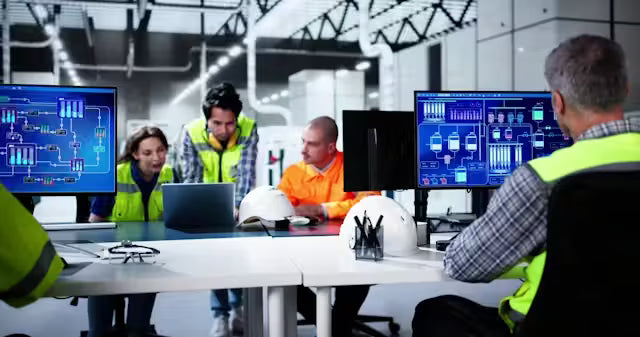
Bridging Workforce Trust Gaps to Scale AI in Industrial Automation
AutoControl GlobalAutoControl Global August 21, 2026Bridging the Workforce Trust Gap to Scale AI in Industrial Automation
While plant managers rapidly adopt advanced algorithms, scaling physical and software systems across global facilities remains difficult. Modern industrial automation relies heavily on reliable control architecture, yet organizational success ultimately depends on operator confidence. Manufacturers must align technological rollouts with workforce communication to convert early pilot programs into fully integrated factory solutions.
The Real Barrier Behind Industrial Automation Scaling Friction
Data shows that 72% of manufacturers now utilize artificial intelligence within their operational workflows. However, a mere 10% successfully scale these initiatives across their entire plant networks. Equipment operators and facility managers rarely struggle with physical hardware installation. Instead, momentum stalls when personnel lack clear visibility into automated decision-making processes.
Resolving Hesitation Across Executive and Operational Control Layers
Leadership caution often mirrors technical skill shortages on the shop floor. Industry surveys indicate that 36% of operational leaders cite integration skill gaps as a primary deployment hurdle. Meanwhile, 53% of shop-floor operators remain open to adopting automated tools. Therefore, executive hesitation stems less from employee stubbornness and more from organizational uncertainty surrounding system performance.
Overcoming Miscommunication to Secure Worker Buy-In for Factory Automation
Frontline staff frequently view new algorithmic systems with healthy skepticism. Roughly 53% of manufacturing workers fear automated tools could jeopardize job security. Because leadership rarely clarifies long-term deployment strategies, operators often perceive predictive software as a direct threat. Transparent communication directly resolves these anxieties by framing advanced software as an operator support tool.
Integrating Operators Early into Control Systems and AI Selection
Successful enterprises refrain from issuing top-down technology mandates without frontline involvement. Instead, engineering teams achieve optimal results by launching targeted pilot projects aimed at specific operational bottlenecks. Plant managers should include senior technicians early during initial vendor selections. As a result, small operational wins organically build trust across the wider technical team.
Building Transparent AI Literacy as a Core Workforce Strategy
Treating system integration strictly as an IT project usually guarantees low operator engagement. Field engineers must understand why a system triggers an alarm, rather than simply reacting to an indicator light. When operators grasp the underlying data streams—such as vibration analysis or thermal drift—they trust automated recommendations and maintain peak production efficiency.
Author Commentary: Why Human Context Remains Essential for Smart Factories
From an industrial engineering perspective, data models cannot replace human intuition on the factory floor. Algorithms excel at identifying subtle cross-variable correlations that human operators might overlook. However, real-time control systems still rely on experienced technicians to make critical judgment calls during process anomalies. Building sustainable smart factories requires enhancing human expertise rather than attempting total human exclusion.
Application Scenario: Predictive Maintenance on a Modern Assembly Line
| Operational Layer | Integrated Solution | Practical Execution & Workforce Impact |
|---|---|---|
| Field Sensing & Data Acquisition | Edge Vibration & Thermal Sensors | Continuous monitoring feeds operational data directly to localized edge analytics nodes. |
| Control Logic & Inference | Machine Learning Analytics Engine | Analyzes real-time anomalies and routes predictive alerts to the central SCADA or DCS interface. |
| Human In-The-Loop Validation | Operator Feedback Interface | Senior technicians verify sensor flags, adjust parameters, and train model accuracy through direct field experience. |
| Enterprise Integration | Automated Work Orders | Confirmed anomalies automatically generate maintenance tickets, avoiding catastrophic downtime. |