
Edge AI vs. Factory Logic: The Future of Predictive Maintenance
AutoControl GlobalAutoControl Global April 16, 2026The Architectural Fault Line: Where Should Industrial Intelligence Live?
The industrial world is currently witnessing a high-stakes tug-of-war over the "brain" of the factory. On one side, semiconductor giants are packing massive inference capabilities into tiny sensors and edge chips. On the other, automation veterans insist that intelligence without process context is merely noise. As an engineer who has walked many factory floors, I see this not just as a technical debate, but as a fundamental shift in how we define machine health. The transition from "cloud-heavy" analytics to "edge-native" maintenance is redefining the very hierarchy of the industrial stack.
Layered Intelligence: Moving Beyond the "AI Everywhere" Hype
There is a common misconception that simply sprinkling AI onto every sensor will magically solve downtime. In reality, a smart sensor can only tell you about its own vibration or temperature; it lacks the "situational awareness" of the entire production line. I strongly advocate for a Layered Intelligence Model. In this framework, the sensor handles high-frequency anomaly detection, the PLC (Programmable Logic Controller) interprets system-level anomalies, and the Edge Gateway analyzes the long-term trends of the entire line. This hierarchy ensures that we don't just detect that something is wrong, but understand why it is happening within the context of the process.
The Brownfield Reality and the "Ghost in the Machine"
Silicon vendors often design for "greenfield" projects—idealized, brand-new factories. However, the reality I face daily is the "brownfield" nightmare: a patchwork of machines spanning three decades and five different vendors. The biggest hurdle to scaling Edge AI isn't the compute power; it is the loss of institutional knowledge. Often, the original design engineers are long gone, leaving us with telemetry data but no "intent" data. Successful predictive maintenance requires bridging this gap by using AI to capture and codify the "tribal knowledge" of senior operators before they retire.
Determinism vs. Discovery: The Trust Gap in Closed-Loop AI
We are seeing incredible advances in AI acceleration, yet most factory managers still refuse to let a machine-learning model trigger an emergency stop or change a PID loop autonomously. This caution is justified. In industrial automation, determinism is king. We cannot afford the "black box" nature of deep learning when safety and millions of dollars in throughput are on the line. My view is that we are currently in the "Advisor Phase": AI detects and recommends, but the human operator remains the final arbiter. Until we can provide explainable AI that meets safety certification standards, the human-in-the-loop will remain a functional necessity.
Silicon Ambition vs. Factory Pragmatism
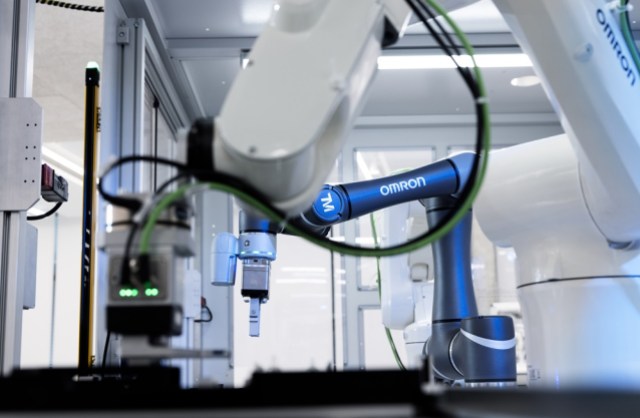
While chipmakers push for heterogeneous AI acceleration at the extreme edge, automation vendors like Omron prioritize reliability and problem-solving. This tension is actually healthy for the industry. It forces semiconductor companies to consider the harsh, oily, and EMI-heavy reality of the plant floor, while pushing traditional vendors to move faster than their typical decadal product cycles. The winners in this space won't be those with the fastest chips, but those who can integrate AI into a deterministic control environment without compromising the "five nines" of industrial uptime.