
Embedded AI & Sensors Lead a New Era in Industrial Automation
AutoControl GlobalAutoControl Global August 10, 2026Hardware-Level Intelligence: How Purpose-Built Industrial AI and Advanced Sensing Reshape Factory Automation
Industrial automation is undergoing a fundamental structural transformation. Modern manufacturing facilities are shifting away from standalone software subscriptions. Instead, automation engineers are embedding artificial intelligence and high-precision sensing directly into control systems, programmable logic controllers (PLCs), distributed control systems (DCSs), and physical hardware.
Recent operational deployments from Emerson, FOBA, Mitsubishi Electric, and IDS Imaging illustrate how embedded algorithms eliminate network latency and streamline factory automation workflows. This hardware-first approach ensures maximum uptime across power grid infrastructure, data center cooling, and precision laser machining.
Edge-Based AI Agents Enhance Fault Detection in Critical Control Systems
Emerson has embedded autonomous AI software agents directly into its edge-level industrial automation platform. This architecture brings native fault detection to water management and municipal power facilities. By processing telemetry locally at the DCS level, the system eliminates traditional cloud roundtrips. Consequently, the edge controller identifies equipment anomalies in milliseconds rather than seconds.
From an operational standpoint, removing cloud latency is essential for critical infrastructure. In high-stakes energy and utility environments, waiting on external analytics engines introduces unnecessary downtime risks. By moving processing power directly to the physical layer, plant engineers achieve true zero-latency failure prevention. Moreover, this shift changes the procurement conversation from evaluating software add-ons to specifying native controller capabilities.
Variable-Wavelength Lasers Redefine Precision in Factory Automation Cells
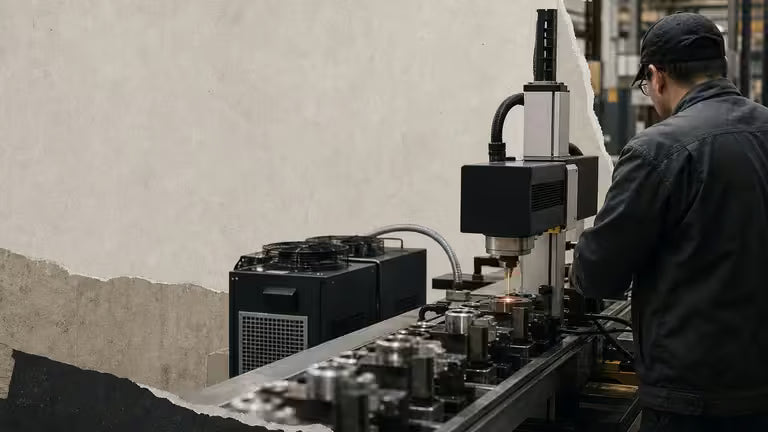
At IMTS 2026, FOBA Laser Marking + Engraving demonstrated dynamic variable-wavelength lasers integrated into fully automated workstations. Traditional marking systems usually require static setups optimized for a single substrate like plastic or steel. However, FOBA's hardware shifts laser wavelengths dynamically inside a single cell, allowing operators to process multiple material types without manual tool changes.
This dynamic flexibility eliminates capital expenditure and saves valuable floor space. Instead of installing two or three dedicated marking stations, plant managers can now deploy a single multi-substrate cell. As a result, this capability lowers total cost of ownership and simplifies production scheduling across busy factory floors.
Domestic IT Cooling Production Addresses AI Compute Demand
Mitsubishi Electric has launched a dedicated manufacturing facility in the United States focused on specialized IT cooling units. Rapid AI infrastructure expansion has created severe lead-time bottlenecks for data center operators. Localizing physical production helps Mitsubishi Electric bypass international supply chain disruptions and accelerate delivery cycles across North America.
In addition, Mitsubishi Electric is shifting toward a single-source service model. Modern hyperscale operators prefer unified contracts that cover physical hardware, preventive maintenance, and emergency response. This operational strategy mitigates downtime risks while strengthening vendor accountability across mission-critical cooling environments.
Sony STARVIS 2 Integration Upgrades Industrial Machine Vision
Complementing these hardware advancements, IDS Imaging expanded its uEye FA industrial camera family with Sony STARVIS 2 sensors. Offering resolutions up to 12.5 megapixels, these ruggedized cameras excel in challenging ambient light conditions. Industrial vision systems can now capture clear image data without requiring specialized external lighting setups.
For quality assurance teams, high-resolution visual sensors simplify physical cell integration. Engineers can inspect minute product defects across wide fields of view using a single fixed camera position. Therefore, factories reduce vision hardware spending while maintaining stringent quality control standards.
Strategic Outlook: Capitalizing on Native Industrial Intelligence
The era of treating industrial AI as a superficial cloud add-on is drawing to a close. Forward-looking manufacturing leaders are reallocating capital toward equipment that offers native edge intelligence, multi-material processing, and integrated service support.
When upgrading factory infrastructure, procurement and operations teams should prioritize these technical criteria:
- Native Edge Processing: Ensure controllers process safety-critical analytics locally at the PLC or DCS layer.
- Consolidated Tooling: Select multi-use workstations that process varied materials within a single footprint.
- Turnkey Vendor Support: Partner with equipment suppliers that combine physical hardware manufacturing with end-to-end service level agreements.
Real-World Application Scenario: High-Precision Automotive Assembly
A Tier-1 automotive component supplier requires real-time fault identification, multi-material laser marking, and visual quality assurance along a fast-paced assembly line.
Workflow Steps:
- Step 1: An Emerson edge controller monitors conveyor motors via local vibration sensors. The embedded AI agent flags micro-anomalies and adjusts belt speed autonomously, preventing catastrophic drive failure without waiting for cloud data processing.
- Step 2: As components pass through the marking station, FOBA's variable-wavelength laser engraves serial numbers onto cast aluminum housings and plastic connector covers back-to-back, maintaining line speed without manual intervention.
- Step 3: An IDS uEye FA camera inspects part geometry and serial clarity under fluctuating factory lighting. The STARVIS 2 sensor's dynamic range delivers high-contrast images directly to the local quality management system.
By integrating intelligence directly into the hardware layer, the manufacturer increases throughput, cuts unplanned downtime, and eliminates redundant equipment costs.