
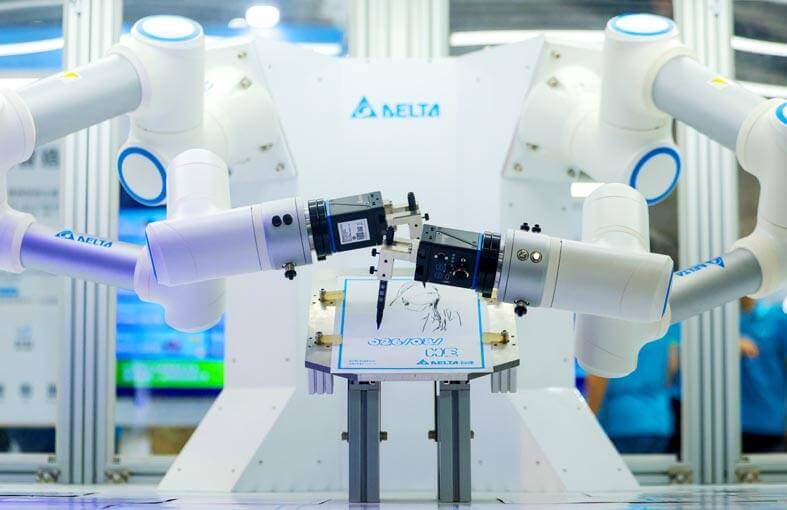
Embodied AI Dual-Arm Cobots and Joint Modules Reshape Industrial Automation
AutoControl GlobalAutoControl Global August 21, 2026The Rise of Embodied AI and Modular Components in Modern Factory Automation
Traditional factory automation relies heavily on preprogrammed motion scripts and rigid production lines. However, recent debuts from automation leaders signal a major shift toward adaptable, software-driven systems. By combining physical AI platforms with advanced motion controls, companies are transforming industrial operations to solve persistent labor shortages and high production friction.
AI-Driven Cobots Redefine Industrial Automation Workflows
Delta Electronics recently introduced an embodied AI dual-arm cobot integrated with Nvidia's platform. Standard collaborative robots require manual reprogramming whenever plant managers change production sequences. Conversely, this AI-driven cobot autonomously plans, adapts, and executes multi-step tasks. Consequently, electronics manufacturers can streamline complex assembly processes like AI server manufacturing without massive operational downtime.
Modular Joint Technologies Power Next-Generation Humanoid Systems
Beyond complete robotic arms, compact motion hardware determines dynamic performance. Delta also unveiled an integrated joint module housing a drive, motor, reducer, encoder, and force sensor. Engineers can implement this versatile unit across both upper and lower limbs of humanoid robots. Furthermore, mastering these core motion hardware components ensures high torque density and precise feedback loops for heavy-duty tasks.
Strategic Focus Shifts from Full Humanoids to Core Control Hardware
While many developers race to launch commercial humanoids, structural industrial adoption requires proven durability. Delta deliberately prioritizes sub-assemblies and control architectures over complete humanoid frames. Executives emphasize building the "brain, cerebellum, and nervous system" of future machinery. Therefore, supplying robust drives, PLCs, and sensor networks offers a faster route to scalable factory integration.
Fully Autonomous Facilities Address Global Labor Shortages
Concurrently, system integrators like Aurotek are demonstrating uncrewed, personnel-less factory frameworks. Their solution coordinates autonomous mobile robots (AMRs), uncrewed forklifts, and retail restocking units into one unified ecosystem. As industrial labor pools continue to shrink worldwide, deploying smart robotics directly mitigates operational bottlenecks. Moreover, aggregating real-world field data accelerates model training for future physical AI applications.
Industry Commentary: Software Intelligence Outweighs Hardware Frames
From an engineering perspective, hardware stability represents only half the industrial automation equation. The true competitive moat lies in software-hardware convergence. While precise joint modules provide mechanical fluidity, real-time AI inference engines deliver contextual adaptability. Companies that focus on modular motion components alongside intelligent control platforms will likely lead the smart manufacturing transition.
Application Scenario: High-Mix, Low-Volume AI Server Manufacturing
| System Layer | Component / Technology | Operational Role |
|---|---|---|
| Control & Brain | Embodied AI + Distributed Motion Control | Analyzes CAD assembly models and dynamically routes motion commands. |
| Actuation & Joints | All-in-One Integrated Joint Modules | Drives precise multi-axis movement using embedded encoders and force sensors. |
| Material Transport | AMRs & Uncrewed Forklifts | Handles raw material delivery and finished goods movement without operator input. |
| System Integration | Industrial Internet of Things (IIoT) | Syncs machine state data with central DCS / SCADA architectures in real time. |