
Honeywell accelerates its deployment of LNG and AI automation
AutoControl GlobalAutoControl Global January 14, 2026Honeywell International Stock Signal: How LNG Infrastructure and AI Automation Drive a Sustainable Breakout
Market Context for Industrial Automation Leaders
The U.S. equity market continues to rise, yet trading volumes show clear divergence.
This pattern often signals short-term uncertainty.
However, diversified industrial automation leaders usually perform well during such phases.
Honeywell operates across industrial automation, control systems, DCS platforms, and energy infrastructure.
As a result, macro volatility often strengthens its relative position rather than weakening it.
From an engineering perspective, companies tied to factory automation and energy security attract capital when growth becomes selective.
Index Signals Favor Defensive Industrial Automation Stocks
Honeywell belongs to the Dow Jones, NASDAQ-100, S&P 100, and S&P 500.
All four indices trade near historical highs.
However, bearish divergences appear beneath the surface.
The Bull Bear Power Indicator shows weakening momentum in the S&P 500.
Therefore, capital rotates toward companies with stable cash flow and infrastructure exposure.
Industrial automation firms often benefit from this rotation.
Improving Market Sentiment Driven by Automation and Energy Technology
Recent announcements reshaped investor sentiment toward Honeywell.
Institutional investors now emphasize LNG technology and AI-driven automation.
The stock gained nearly six percent within one week.
This move followed two strategic developments.
Both directly support long-term automation demand.
In my experience, markets reward companies that link control systems expertise with real-world infrastructure projects.
LNG Partnerships Reinforce Honeywell’s Process Control Leadership
In January 2026, Honeywell partnered with Technip Energies.
The project supports a large LNG export facility in Louisiana.
Honeywell supplies coil wound heat exchangers and UOP SeparSIV pretreatment technology.
These systems form the backbone of modern LNG control architecture.
From a DCS engineering standpoint, modular LNG solutions reduce commissioning risk.
As global energy security remains critical, LNG automation demand will likely expand for years.
AI Integration Extends Honeywell’s Industrial Automation Footprint
Honeywell also introduced an AI-powered Smart Shopping Platform.
The solution integrates Google Cloud AI with Honeywell industrial hardware.
Although retail-focused, the architecture mirrors factory automation principles.
It combines edge devices, cloud analytics, and real-time control logic.
This approach reflects a broader trend.
Industrial automation increasingly merges PLC logic, AI inference, and digital twins.
In my view, Honeywell applies proven control systems thinking to new industries effectively.
Strong Margins Reflect High-Quality Automation Revenue
Honeywell consistently delivers operating margins above many peers.
Margins typically range between sixteen and eighteen percent.
Software, aftermarket services, and automation platforms drive this performance.
These revenue streams scale efficiently and resist pricing pressure.
As LNG projects and AI platforms scale, operating leverage should improve further.
Capital Efficiency Supports Long-Term Automation Investment
Return on invested capital remains well above the cost of capital.
This metric confirms genuine value creation.
Honeywell reinvests in high-return automation platforms rather than speculative growth.
This discipline supports dividends, buybacks, and system innovation simultaneously.
From an engineering business perspective, this balance sustains long-term credibility.
Valuation Remains Reasonable for a High-Quality Control Systems Provider
Honeywell trades near twenty-two times earnings.
The broader market trades significantly higher.
Given Honeywell’s exposure to industrial automation, DCS systems, and energy infrastructure, this discount appears unjustified.
Analyst targets now range above two hundred thirty dollars.
Upside exists if LNG adoption or AI automation accelerates faster than expected.
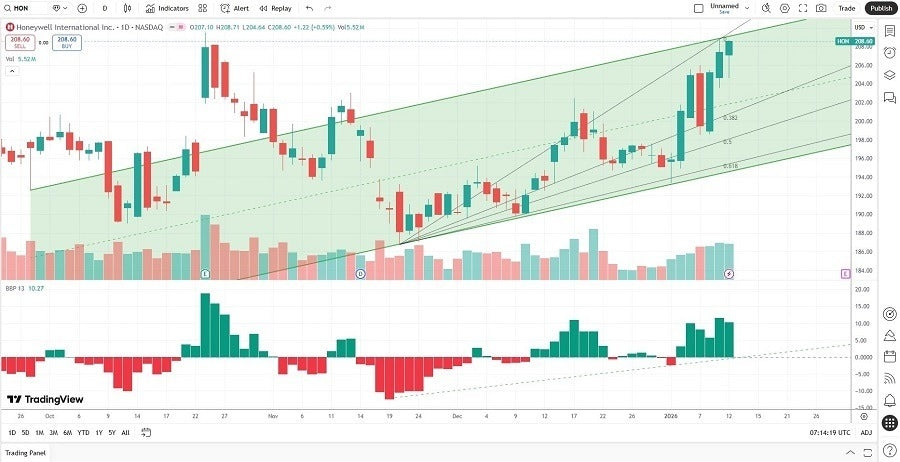
Technical Structure Supports a Controlled Long Entry
The stock recently reclaimed its 200-day moving average.
Volume confirms institutional participation.
Support sits near two hundred five dollars.
Resistance appears near two hundred fifteen dollars initially.
This structure offers favorable risk control for disciplined entries.
In volatile markets, defined levels matter more than momentum chasing.industrial automation,control systems,LNG process contro