
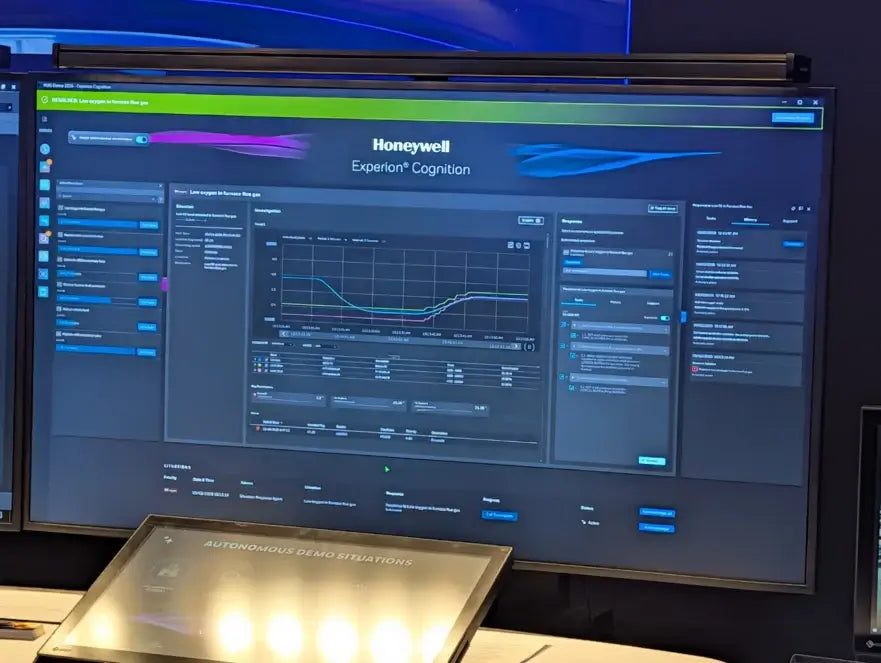
Honeywell Experion Cognition Advances Autonomous DCS Technology
AutoControl GlobalAutoControl Global June 24, 2026Honeywell Experion Cognition Signals Shift to Autonomous DCS Technology
Industrial AI Steals the Spotlight at HUG 2026
The recent Honeywell User Group (HUG) conference in Phoenix highlighted a significant shift in factory automation history. Industry experts witnessed numerous product rollouts that embedded industrial AI deep within core control architectures. While vendors frequently pitch AI as a reactive decision support tool, one particular announcement demonstrated far greater capabilities. Honeywell showcased a landmark project executed alongside Borouge in the UAE. This specific deployment represents a definitive milestone because it proves a process facility can run autonomously. Consequently, the development redefines how engineers view modern distributed control systems (DCS).
Borouge Deepens Global Polyolefin Production Footprint
Established in Abu Dhabi in 1998, Borouge operates as a major joint venture. The enterprise unites the Abu Dhabi National Oil Company (ADNOC) with Borealis of Austria to manufacture high-grade polyolefin plastics. Furthermore, a massive $9.7 billion corporate merger consolidated Borouge with Borealis and Nova Chemicals. This strategic consolidation established a $60 billion global production entity. The unified corporation now ranks as the fourth-largest polyolefins manufacturer worldwide by capacity. Therefore, its operational decisions carry immense weight across the international chemical processing landscape.
Autonomous Control Rooms Redefine Petrochemical Facilities
The collaborative proof-of-concept (POC) project focused on autonomous operations at the Ruwais petrochemical facility. This initiative serves as a core pillar of Borouge’s ambitious AI, Digitalization & Technology program. This broad technology optimization campaign targeted $575 million in corporate value generation. Through this deployment, Borouge actively pushes toward ADNOC’s ultimate goal. The state enterprise aims to become the most AI-enabled energy organization worldwide. Thus, the Ruwais trial establishes a verified baseline for next-generation factory automation.
Verified Live Field Trials Confirm High Efficiency Gains
Engineers conducted the comprehensive field trials directly within a live, high-throughput production environment. The documented results indicate that industrial AI can optimize plant metrics simultaneously. Specifically, the site realized an efficiency increase reaching up to 20 percent. The implementation also enhanced overall reliability by reducing costly system downtime by 20 percent. Moreover, the platform curtailed total operating costs by 15 percent while lowering energy consumption. As a result, both carbon emissions and sudden process safety hazards decreased during active loops.
Proactive Failure Prevention Minimizes Plant Alarm Incidents
At the center of this field success stands Honeywell Experion Cognition. The platform officially debuted at HUG 2026 to pioneer advanced autonomous control rooms. This industrial software combines deep automation expertise with predictive machine learning models. For example, an integrated Operations Assistant actively predicts anomalies ahead of traditional safety alarms. During multiple live factory pilots, the software forecasted process deviations 5 to 10 minutes early. Therefore, the architecture mitigates abnormal situations before traditional emergency trip systems must activate.
Mitigating the Automation Engineering Labor Shortage Crisis
The process industry currently faces an accelerating wave of veteran operator retirements. This severe skills gap makes it difficult to capture historical automation expertise digitally. Experion Cognition solves this specific issue by automating abnormal situation management tasks. The system successfully delegates highly complex cognitive processing to autonomous software agents. Consequently, less experienced technicians can run volatile process loops with veteran-level proficiency. This technological bridge stabilizes plant uptime despite shifting workforce demographics.
Flexible Dual Architecture Keeps Humans in the Loop
Despite its autonomous capabilities, Experion Cognition provides versatile operational flexibility. Plant managers can implement the software using a gradual, step-by-step approach. Under this hybrid framework, the AI continuously monitors the DCS and alerts staff to anomalies. However, the human operator retains final authority to execute critical field corrections. This adjustable configuration allows conservative industrial plants to adopt autonomous solutions smoothly. It builds team trust before facilities transition to total hands-off automation.
Industrial AI Breaks the Process Control Logjam
For years, the control room experience consisted of long inactivity broken by frenetic troubleshooting. This stressful operational loop resembles the unpredictable workflow that emergency first responders face daily. Industrial AI serves as the definitive dam breaker to change this reactive paradigm. By automating routine loop tuning and alarm triage, software frees up operator time. Personnel can now shift their focus toward active process optimization and yield maximization. The technology charts a clear path toward truly resilient industrial facilities.
Real-World Solution Scenario: Automated Distillation Column Stabilization
In a typical petrochemical processing scenario, a feed composition upset destabilizes a major distillation column. In a traditional DCS environment, the upset triggers a cascade of confusing nuisance alarms. The operator must then frantically adjust reboiler steam valves and reflux ratios manually to avoid a costly plant trip.
With Experion Cognition deployed, the predictive models detect the incoming feed density change 10 minutes prior to the first alarm. The system automatically calculates the required adjustment using real-time thermodynamic data. It then smoothly transitions the regulatory control loops to the new setpoints using active voice notifications. As a result, the column remains completely stable, emissions stay within regulatory limits, and the human operator focuses on long-term production scheduling.