
How AI in Industrial Automation Solves Manufacturing Staff Shortages
AutoControl GlobalAutoControl Global March 24, 2026Harnessing AI in Industrial Automation to Solve Labor Shortages and Productivity Gaps
The global manufacturing landscape currently faces a dual crisis: a chronic shortage of skilled technical personnel and a plateau in traditional productivity gains. While sectors like finance and retail have rapidly integrated artificial intelligence, industrial automation has progressed more cautiously. However, recent data suggests that AI is no longer a luxury but a fundamental necessity for factory survival.
Large-Scale Enterprises Lead the AI Charge
Adoption rates for AI in manufacturing correlate strictly with company size. Large enterprises with over 250 employees implement AI three times more frequently than small-to-medium enterprises (SMEs). This disparity exists because larger firms possess the capital and data infrastructure required for complex deployments. Nevertheless, the return on investment (ROI) for most industrial AI projects now materializes within one to four years, making it an attractive prospect for smaller firms seeking to scale.
Analyzing the European Industrial AI Landscape
Industrial AI adoption varies significantly across the European Union. Belgium and Denmark currently lead the sector, with nearly 40% of their manufacturers utilizing at least one AI technology. In contrast, the German manufacturing sector, long considered the "powerhouse" of Europe, has shown slower software investment growth. To maintain a competitive edge against global rivals, traditional industrial hubs must accelerate their transition from hardware-centric models to software-defined production.
Expanding Beyond Core Manufacturing Processes
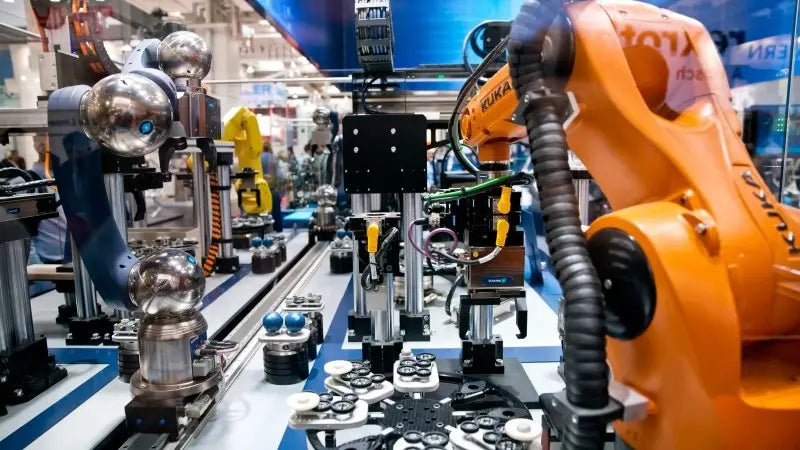
While robots and PLCs (Programmable Logic Controllers) have already automated core production lines, the most significant untapped potential lies in "non-core" processes. AI delivers immense value in logistics, maintenance, and administrative support. For instance, AI-driven predictive maintenance can identify a failing bearing in a motor long before a human technician notices the vibration. This shift allows human staff to focus on high-value engineering tasks rather than repetitive monitoring.
Driving Efficiency Through Generative Design and Simulation
Generative AI (GenAI) is revolutionizing the engineering phase of manufacturing. Companies like BMW and Siemens now use synthetic datasets to train vision models for quality control. By simulating 800,000 images of assembly tasks, manufacturers reduce the time required to develop quality models by over 60%. These digital twins and simulations allow for "First Time Right" manufacturing, which drastically cuts material waste and energy consumption.
Building a Foundation of Reliable Data Infrastructure
Successful AI implementation requires a robust data foundation. Manufacturers must bridge the gap between Information Technology (IT) and Operational Technology (OT). Without "clean" data from sensors and control systems, AI models cannot produce reliable insights. Therefore, companies must prioritize digitizing their processes and ensuring consistent data flow before attempting large-scale AI integration.
Expert Insight: Overcoming the Human Element of Automation
From a technical perspective, the greatest hurdle to AI adoption is often not the software, but the "human friction" within the organization. Workers frequently fear that AI will lead to job losses. However, the current labor squeeze suggests the opposite; AI acts as a "force multiplier" for a dwindling workforce. I believe that management must involve floor-level technicians early in the pilot phase. When a technician sees an AI agent successfully writing code for a robot driver or translating a complex manual into a work instruction, the technology becomes a partner rather than a threat.
Practical Application: AI-Driven Quality Inspection
In a typical factory automation scenario, a high-speed assembly line produces thousands of components per hour. Traditional manual inspection is prone to fatigue and error. By integrating an AI-powered vision system with an RX3i or similar PLC backplane, the system can detect microscopic defects in real-time.
-
The Scenario: A food packaging plant uses deep-learning models to inspect seal integrity.
-
The Result: The system corrects machine settings automatically when it detects a trend toward deviation, reducing rejects by 15% and ensuring 100% compliance with safety standards.