
Industrial Automation Evolution: From Legacy PLCs to AI Robotics
AutoControl GlobalAutoControl Global June 16, 2026The Evolution of Industrial Automation: From Mechanized Floors to AI-Driven Smart Ecosystems
The manufacturing sector has always served as a primary mirror of human progress. Since economic historian Arnold Toynbee first coined the term "Industrial Revolution," the sector has continuously embraced technological innovation as its ultimate lifeblood. Today, we are witnessing a massive digital transformation. Factories are migrating from traditional, isolated setups into highly interconnected, data-driven smart environments. This evolution marks a transition from the foundational Industry 4.0 paradigms into the human-centric frameworks of Industry 5.0.
The Automation Foundation: How PLCs and Robotics Reshape the Factory Floor
Automation remains the absolute cornerstone of modern manufacturing transformation. While early mechanization focused entirely on replacing manual labor with basic machinery, contemporary industrial automation handles incredibly intricate processes. Today, advanced hardware components drive factory automation with minimal human intervention.
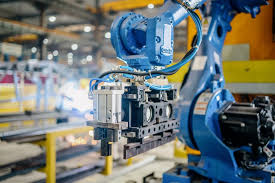
Programmable Logic Controllers (PLCs) and Distributed Control Systems (DCS) now serve as the reliable nervous system of the production line. Modern PLCs manage high-speed sorting and precise machine movements, while a centralized DCS coordinates complex, plant-wide chemical processes. In this environment, heavy-duty industrial robots weld, assemble, and package goods with unmatched speed. Concurrently, collaborative robots, or cobots, work directly alongside human operators to boost overall shop-floor productivity.
The Power of Connectivity: Harnessing IIOT and Control Systems
Digitalization introduces a deep layer of sophistication to operational workflows. The rapid rise of the Industrial Internet of Things (IIoT) successfully bridges physical control systems with digital networks. Consequently, every single robotic movement, motor vibration, and temperature fluctuation is captured by smart sensors.
This constant exchange of information empowers plant managers to transition away from reactive maintenance. Instead, they leverage data-driven predictive maintenance strategies. By analyzing real-time performance metrics, engineering teams can service critical machinery before any actual failure occurs. Therefore, smart factories drastically reduce unplanned downtime, optimize asset lifecycles, and maintain continuous production flow.
- Field Layer: Sensors and actuators capture physical metrics.
- Control Layer: PLCs and DCS manage real-time edge operations.
- Network Layer: IIoT gateways transmit data securely.
- Enterprise Layer: Cloud analytics and digital twins optimize performance.
Intelligence Actioned: Implementing AI and Machine Vision in Production
Artificial Intelligence acts as the primary brain behind modern, adaptive manufacturing facilities. Advanced AI algorithms quickly sift through massive datasets to identify subtle anomalies that human eyes easily miss.
- Workflow Optimization: AI dynamically recalculates scheduling to eliminate bottlenecks.
- Predictive Forecasting: Systems analyze market trends to align raw material procurement with real-time demand.
- Microscopic Quality Control: High-resolution machine vision systems inspect components on fast-moving conveyor belts, instantly rejecting defective parts.
By embedding AI across the entire value chain, manufacturers create a seamless, self-correcting loop that spans from raw supply to the final delivered product.
Redefining Production Limits: Additive Manufacturing and 3D Printing
The current industrial era is witnessing a profound paradigm shift through additive manufacturing. Traditional subtractive methods rely heavily on cutting away material, which inherently generates significant industrial waste. In contrast, industrial 3D printing constructs highly complex geometries layer by layer.
This technological leap allows aerospace firms to manufacture ultra-lightweight engine components that were previously impossible to forge. Similarly, medical device manufacturers use additive systems to produce patient-specific implants on demand. Ultimately, this technology enables cost-effective customization at scale while shortening the prototyping cycle from months to mere hours.
Eco-Efficiency: Driving Sustainability Through Smart Grids
Sustainability has evolved from a regulatory compliance burden into a core driver of modern technological adoption. Today, forward-thinking manufacturers view eco-efficiency as an excellent opportunity to capture financial and environmental benefits simultaneously.
Modern production facilities integrate energy-efficient machinery directly with smart grids and dedicated energy management systems. These platforms monitor power consumption patterns in real time to minimize peak-demand charges. Furthermore, circular economy principles now guide product lifecycles, ensuring that waste materials are systematically captured, recycled, and reused within the production loop.
Virtualizing the Physical: Cloud Platforms and Digital Twins
Cloud computing provides the scalable infrastructure required to store, process, and share industrial data across global manufacturing networks. This cloud backbone enables seamless collaboration among decentralized engineering teams.
Simultaneously, digital twins—highly accurate virtual replicas of physical assets—are revolutionizing industrial design and troubleshooting. Engineers use these virtual models to simulate machine performance under extreme operational stress without risking actual shop-floor equipment. As a result, companies can safely test complex production scenarios and accelerate innovation cycles.
The Empowered Worker: Human-Machine Collaboration in Industry 5.0
Modern technological adoption does not eliminate the human element; instead, it elevates it. Unlike the dystopian, mechanized fears famously satirized in Charlie Chaplin’s Modern Times (1936), modern automation liberates workers from repetitive, hazardous tasks.
The emerging Industry 5.0 paradigm focuses explicitly on the unique human edge. Comprehensive corporate training programs now focus heavily on data literacy, analytical troubleshooting, and human-machine collaboration. Workers have successfully transitioned from basic machine operators into intelligent supervisors who guide automated systems with creativity, strategic insight, and critical judgment.
Expert Commentary: Navigating the Future of Industrial Automation
Industry Insight: The rapid convergence of PLCs, edge AI, and cloud-based digital twins represents a permanent shift in global manufacturing competitiveness. However, true operational excellence requires more than just buying advanced hardware.
Success depends on a company's willingness to break down the traditional silos between Operational Technology (OT) and Information Technology (IT). Organizations that prioritize open communication standards, robust cybersecurity protocols, and continuous workforce upskilling will successfully dominate the market. Meanwhile, rigid operations that resist integration risk swift obsolescence.
Real-World Application Scenario: Automotive Component Assembly
To understand how these technologies converge, consider a modern automotive Tier-1 supplier manufacturing smart braking systems:
The Challenge
The manufacturer needed to assemble customized braking units for multiple vehicle models on a single production line while maintaining zero-defect quality standards.
The Solution
- Control Tier: High-performance PLCs manage the synchronized movement of high-speed assembly conveyors.
- Robotics Integration: Vision-guided cobots work alongside operators to position delicate electronic sensors into the brake housing.
- Quality Assurance: An AI-driven machine vision system scans every finished unit, verifying seal integrity and part placement at a microscopic level.
- Data Layer: The entire process syncs with a cloud-based digital twin, giving managers immediate visibility into total throughput and localized machine health.
The Result
The facility successfully achieved a 30% reduction in assembly cycle times, eliminated manual inspection bottlenecks, and reached a near-zero defect rate.