
Physical AI in Factory Automation: Bridging Research & Production
AutoControl GlobalAutoControl Global September 03, 2026Physical AI in Factory Automation: Bridging Robotics Research and Industrial Deployment
Physical AI is transforming modern factory automation by connecting advanced research models with industrial applications. Companies can now combine intelligent perception, high-precision force sensing, and adaptive control systems in real-world environments. During recent events in Zurich and Bremen, Agile Robots and Franka Robotics showcased this integrated approach. They demonstrated how torque-controlled cobots and data collection platforms accelerate the transition from lab research to shop-floor deployment.
Precision Assembly with Force-Controlled Industrial Automation Systems
Traditional fixed automation struggles when handling small mechanical tolerances and complex insertion tasks. The Diana 7 cobot overcomes this limitation by utilizing integrated torque sensors across all seven joints. During engine head insertion tests, the robot measures applied force in real time to prevent component jams. Consequently, manufacturers can protect delicate parts without adding expensive external sensor hardware. Integrating force feedback with existing PLC and DCS frameworks ensures smooth assembly performance in high-precision factory automation environments.
Simplifying Path Programming for Robotic Welding in Control Systems
Industrial welding applications demand high path accuracy along complex metallic joints and narrow gaps. The Thor 12 robot addresses this challenge through intuitive drag-and-drop teaching and low-code programming. Operators can set up stable welding routines across corner, vertical, and inclined paths with 1 mm gaps. As a result, facilities reduce deployment times while maintaining consistent seam quality without extensive manual coding. This capability lowers barriers for small and medium enterprises implementing flexible control systems.
Collecting Teleoperation Data for Advanced Bimanual Robot Training
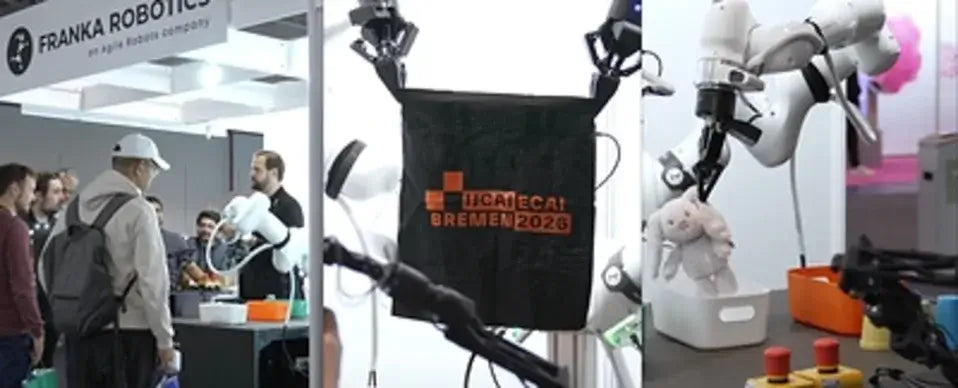
Scaling physical AI relies on acquiring high-quality demonstration datasets for complex manipulation skills. At IJCAI-ECAI 2026, Franka Robotics demonstrated the Franka GELLO Duo interface teleoperating the FR3 Duo platform. The integrated LABS environment captures real-time motion and force profiles during dual-arm tasks. Consequently, AI developers turn human movement into structured training data for machine learning models. This unified workflow streamlines dataset creation for advanced bimanual manipulation research.
Unifying Research Platforms with Scalable Factory Automation Solutions
Connecting academic research tools with industrial production hardware creates a clear pathway toward autonomous manufacturing. Agile Robots leverages its Munich heritage and global footprint to scale intelligent robotics globally. Modern enterprises can deploy reference hardware during initial research phases and transition directly to industrial production. Moreover, unified software interfaces reduce integration friction between experimental neural networks and standard plant control architectures.
Industry Commentary: The Shift Toward Embodied Intelligence
The industrial automation sector is shifting from deterministic programming toward adaptive, sensor-driven execution. Programmable logic controllers remain essential for deterministic machine control and safety loops. However, physical AI introduces dynamic decision-making for unpredictable manufacturing variables. By pairing force-sensitive robotic arms with edge AI processing, plants handle material variations without line stops. Early adopters of hybrid AI-PLC architectures will gain significant competitive advantages in operational agility.
Practical Application Scenario: Engine Block Assembly Line
An automotive powertrain facility integrated force-sensitive cobots into its cylinder head assembly cell. The plant previously experienced frequent component damage due to minor casting variations. Engineers deployed torque-monitored robotic arms interfaced directly with the cell PLC. The force-guided feedback loop automatically adjusted alignment during insertion cycles. Consequently, the line reduced scrap rates by 40% and improved overall equipment effectiveness across two production shifts.