
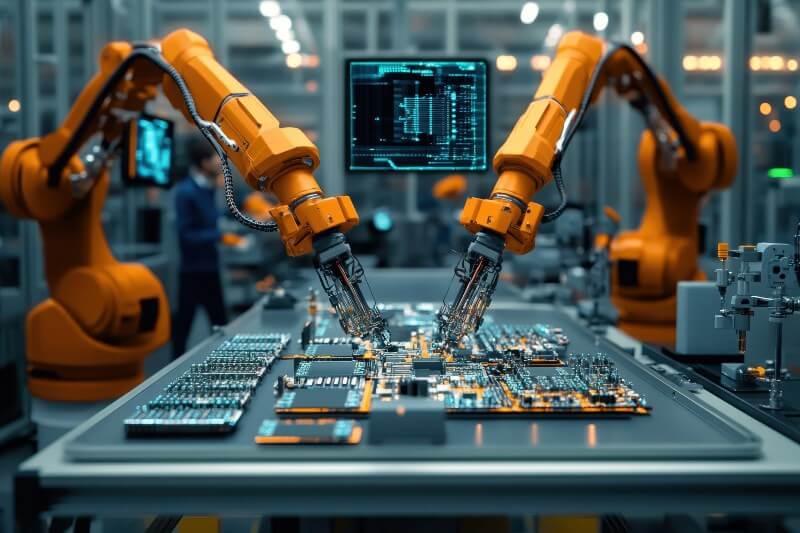
Robotics for Chip Assembly Market to Reach $17.1B by 2036
AutoControl GlobalAutoControl Global July 29, 2026Semiconductor Assembly Robotics Market Set to Surge Past $17 Billion by 2036
Global electronics manufacturing is undergoing a massive transformation. Driven by smart factory adoption and soaring semiconductor investments, the demand for precision assembly robotics is accelerating rapidly. According to a new study by Future Market Insights (FMI), the global electronics and semiconductor assembly robotics market will grow from $6.6 billion in 2026 to $17.1 billion by 2036. This expansion represents a strong compound annual growth rate (CAGR) of 10%. Consequently, the industry will see an incremental revenue opportunity of $10.5 billion over the next decade.
Driving Forces in Industrial Automation and Factory Automation
Several macroeconomic factors are accelerating this market surge. First, massive investments in semiconductor fabrication plants and Electronics Manufacturing Services (EMS) are creating new pipelines. Second, the rapid explosion of artificial intelligence (AI), electric vehicles (EVs), and consumer electronics demands next-generation hardware. To meet these needs, manufacturers are aggressively adopting factory automation strategies. Industry 4.0 technologies allow facilities to optimize throughput while minimizing production errors. Therefore, automation is no longer a luxury but a baseline requirement for global competitiveness.
The Domination of SMT Placement Systems in Control Systems
Surface-mount technology (SMT) remains the cornerstone of modern electronics production lines. Experts project that SMT placement systems will capture 38% of the total market revenue in 2026. These specialized robotic platforms excel at placing microscopic components onto printed circuit boards (PCBs) with incredible speed. In the world of control systems, precision motion control and advanced vision integration are vital. As microchips become smaller and more complex, traditional manual assembly becomes entirely impossible. Thus, SMT systems act as the primary engine driving factory floor efficiency.
Hardware Infrastructure Rules the Robotics Landscape
Robotic hardware forms the physical backbone of this automation wave. Hardware components—including robotic arms, controllers, motion systems, and machine vision equipment—will account for 66% of total market demand. Manufacturers are intentionally choosing modular industrial automation platforms to future-proof their assembly lines. These systems rely heavily on advanced PLC (Programmable Logic Controller) architectures and DCS (Distributed Control Systems) to synchronize complex movements. As a result, robust hardware investments remain the top priority for operations managers worldwide.
Navigating High Capital Costs and Integration Challenges
Despite bright growth prospects, the robotics market faces notable headwinds. High upfront capital costs frequently deter small and medium-sized enterprises from automating. Furthermore, integrating legacy equipment with modern AI platforms creates technical friction. The industry also grapples with a severe shortage of skilled automation engineers who understand complex control systems. Technology evolves rapidly, meaning hardware can become obsolete within a few years. However, forward-thinking companies are mitigating these risks by investing in collaborative robots (cobots) that offer easier programming and faster deployment times.
Regional Growth Engines and Domestic Supply Chain Resilience
Geographically, East Asia will maintain its dominant market leadership. The region benefits from an unparalleled semiconductor manufacturing footprint and continuous government backing. Meanwhile, North America and Europe are experiencing strong growth. Western governments are actively subsidizing domestic fabrication facilities to reduce reliance on foreign supply chains. This geopolitical shift stimulates local demand for advanced robotics. Consequently, systemic investments in domestic smart factories will continue to reshape global manufacturing hubs over the next decade.
Author Insight: The Real-World Impact of Next-Gen Automation
From an industry perspective, this growth trajectory highlights a deeper shift toward completely autonomous production. The integration of AI with machine vision is changing how PLC and DCS networks operate. Modern assembly lines no longer just follow fixed scripts. Instead, they adapt in real-time to component variations. While the $17 billion market forecast is impressive, successful implementation depends entirely on software flexibility. B2B buyers should focus on open-architecture robotic systems. Investing in scalable software will prevent costly hardware lock-in as technology advances.
Practical Application Scenario: High-Speed Silicon Wafer Dicing and Packaging
In a modern semiconductor back-end facility, precision is measured in micrometers. This solution scenario illustrates how integrated robotics optimize the assembly workflow:
- The Challenge: A manufacturer needs to transition from consumer-grade chips to automotive-grade AI processors, requiring zero-defect assembly and higher thermal resistance.
- The Solution: The facility deploys a high-speed delta robotic arm controlled by a centralized DCS framework. The robot works alongside an SMT placement system equipped with AI-powered machine vision.
- The Process: A PLC system manages the conveyor tracking, feeding real-time positional data to the robotic controller. Machine vision cameras scan each die for microscopic fractures at a rate of 120 parts per minute.
- The Result: The automated system successfully places components with a repeatable accuracy of ±10 microns. By replacing manual inspection with closed-loop factory automation, the plant increases yield by 14% and eliminates human handling errors entirely.