
Rockwell Automation in Singapore: Smart Factory & Global Scaling
AutoControl GlobalAutoControl Global July 28, 2026Scaling Smart Manufacturing Globally: How Rockwell Automation Leverages its Singapore Hub for Advanced Industrial Automation
The global market for industrial automation and smart manufacturing will approach US$440 billion by 2030. Within this expanding landscape, Rockwell Automation driving digital transformation across more than 100 countries. The company provides the essential infrastructure behind critical sectors like pharmaceuticals, automotive assembly, and semiconductor fabrication. By co-locating R&D and manufacturing in Singapore, Rockwell has created a powerhouse for testing new control systems. This integrated setup serves as a highly successful model for modern factory automation worldwide.
Co-Located R&D and Manufacturing Accelerates Time to Market
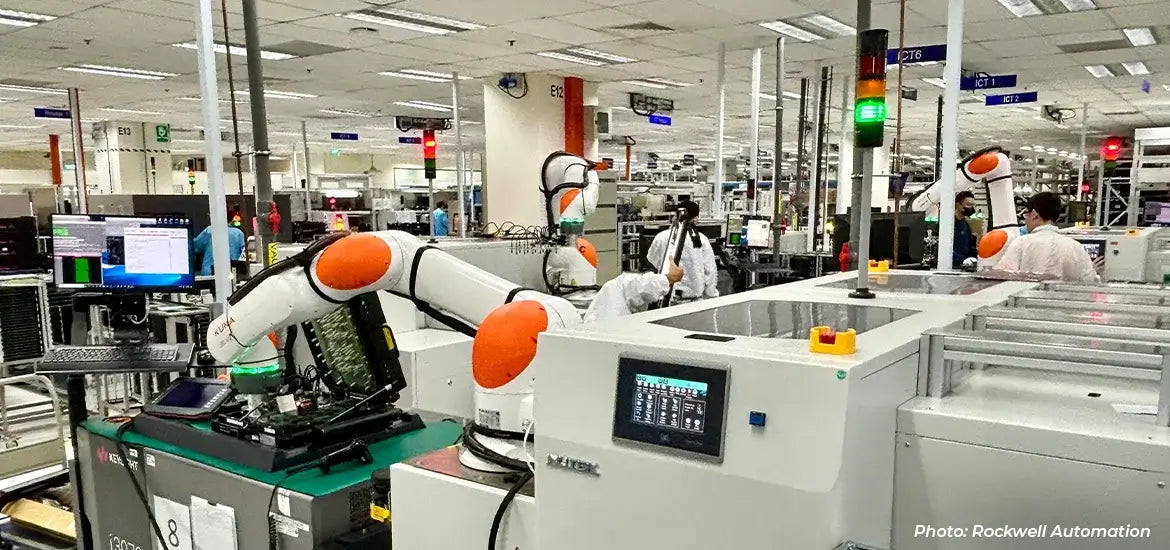
Traditional industrial design often isolates the development team from the actual factory floor. However, Rockwell breaks this barrier by integrating its R&D and production lines within a single Singapore facility. Engineers test advanced prototypes directly on live production setups to validate design changes in real time. Therefore, this close collaboration significantly shortens development cycles and reduces engineering friction. Many innovations engineered here have rapidly evolved into the company's fastest-growing global product lines. Consequently, these local breakthroughs now set new productivity benchmarks across Rockwell's entire global production network.
Industry 4.0 Applications Drive Unprecedented Plant Floor Productivity
Deep digital infrastructure allows modern facilities to turn localized operations into a global launchpad for innovation. Rockwell has successfully deployed more than 50 distinct Industry 4.0 applications inside its Southeast Asian hub. These implementations feature AI-powered quality inspection, autonomous mobile robots (AMRs), and predictive maintenance systems. As a direct result, the plant has successfully reduced product defects by 35 percent. Furthermore, the site has boosted overall labor productivity by 43 percent while slashing worker training timelines by 67 percent. These measurable upgrades provide undeniable proof-of-concept models for global clients planning similar advanced factory automation deployments.
Global Lighthouse Recognition Solidifies Modern Control Systems Leadership
Operational excellence recently earned the facility a prestigious place in the World Economic Forum’s Global Lighthouse Network. Announced in June 2026, this designation confirms the site as a premier advanced manufacturing operation. The achievement marks Singapore's seventh Lighthouse factory, representing the highest concentration in Southeast Asia. Moreover, the facility coordinates complex operations using highly reliable PLC and DCS networks. This recognition proves that investing in robust fieldbus communication and smart hardware yields massive efficiency returns. Procurement teams can safely look to this site as a validated blueprint for large-scale enterprise integration.
Strategic Ecosystem Partnerships Secure Long-Term Technology Roadmaps
A facilitative business environment remains critical for anchoring long-term hardware and software development investments. The Singapore Economic Development Board actively supports Rockwell by building strong bridges to local research institutes like A*STAR. Additionally, these connections help the company recruit top-tier talent across software engineering, data analytics, and advanced controls. Rockwell utilizes this highly skilled workforce to imbed cutting-edge cybersecurity features right at the initial design phase. Consequently, new products comply early with strict international regulations like the European Union's Cyber Resilience Act. The facility also pioneers eco-friendly designs to help industrial clients adapt to tightening environmental laws.
Technical Insights: The Author's Perspective
From a controls engineering viewpoint, Rockwell's success proves that hardware-software convergence requires physical proximity to the production line. Simulation tools are powerful, but validating PLC code and DCS configurations against physical machinery yields superior reliability.
Furthermore, proactively designing for the EU Cyber Resilience Act highlights an critical industry shift. Modern industrial automation can no longer separate operational efficiency from robust data security. System integrators should mimic this approach by prioritizing edge devices that feature built-in, hardware-level encryption.
Solutions Scenario: High-Tech Semiconductor Sub-Assembly Line
To visualize how these local innovations scale into global best practices, look at a high-tech electronics environment:
- The Challenge: A semiconductor equipment manufacturer faces rising defect rates and frequent downtime on a mixed-model assembly line.
- The Solution: The plant implements an integrated Software & Control layer developed and validated in Rockwell’s Lighthouse facility. The architecture combines predictive maintenance algorithms with AI vision inspection systems running on high-speed industrial controllers.
- The Strategic Outcome: Real-time production data flows securely across an encrypted network, preventing unauthorized access. The system identifies component wear before failure occurs, boosting total equipment effectiveness. This exact setup, perfected in Singapore, now deploys seamlessly to manufacturing facilities across China, India, and the United States.