
Rockwell Automation Strengthens Industrial Automation with AI Integration
AutoControl GlobalAutoControl Global January 02, 2026Rockwell Automation Stock Outlook: AI-Driven Growth in Industrial Automation
Introduction to Rockwell Automation and AI Strategy
Rockwell Automation, Inc. (NYSE: ROK) remains a leading force in industrial automation and control systems. Although the stock closed at $393.68 with a slight daily decline, its long-term direction reflects strong confidence in AI-enabled factory automation. From my industry experience, companies that combine PLC, DCS, and advanced analytics usually outperform peers during technology transitions.
AI Integration in Industrial Automation
Rockwell continues to embed artificial intelligence across its industrial automation portfolio. These AI-driven solutions improve predictive maintenance, process optimization, and real-time decision-making. As a result, manufacturers gain higher uptime and better asset utilization.
Moreover, Rockwell’s software-focused approach differentiates it from competitors like Siemens and ABB. By integrating AI into control systems and industrial software, Rockwell supports industries that demand precision, such as automotive and semiconductor manufacturing.
Competitive Position in Factory Automation
Competition in factory automation remains intense. However, Rockwell’s focus on digital transformation strengthens its positioning. The company aligns PLC and DCS platforms with analytics and cloud-based services. Therefore, customers can scale automation systems without replacing existing infrastructure.
In addition, Rockwell benefits from strong partnerships and compliance with global industrial standards. This reinforces trust among system integrators and end users.
Financial Performance and Market Indicators
Despite short-term volatility, Rockwell’s stock performance shows resilience. The share price remains well above its 50-day moving average, signaling continued investor confidence. Year-to-date gains significantly exceed the broader industrials sector.
Key financial indicators also support this outlook. Strong operating cash flow reflects disciplined cost management. Furthermore, the valuation premium suggests the market expects sustained earnings growth from AI-driven solutions.
Analyst Views and Earnings Expectations
Analyst sentiment toward Rockwell remains positive. Most analysts rate the stock as a Buy, while others maintain Hold positions. This consensus reflects confidence in Rockwell’s execution within industrial automation markets.
Upcoming earnings estimates point to continued performance improvement. Historically, Rockwell has exceeded expectations by delivering operational efficiency and software-led growth. Therefore, many investors expect this trend to continue.
Price Forecast and Industrial Sector Trends
Forecast models suggest modest near-term upside for ROK shares. Over a longer horizon, price projections fluctuate due to macroeconomic uncertainty. However, AI adoption in industrial automation continues to accelerate.
As a result, companies with strong PLC, DCS, and control systems portfolios may benefit. Rockwell’s focus on intelligent automation positions it well within this evolving landscape.
Author’s Perspective on AI and Control Systems
From a practical standpoint, AI integration in control systems reduces unplanned downtime. I have seen factories achieve measurable gains by combining PLC data with analytics platforms. Rockwell’s strategy aligns with these real-world outcomes.
However, investors should monitor execution risks and competitive pressure. Continuous innovation remains essential in fast-moving industrial automation markets.
Practical Application Scenarios
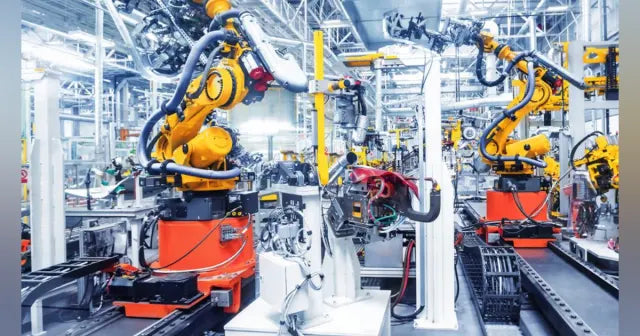
Rockwell’s AI-enabled solutions support multiple use cases. Automotive plants use predictive analytics to optimize robotic assembly lines. Semiconductor facilities rely on precise process control to reduce yield loss. In energy and chemicals, advanced control systems improve safety and efficiency.
These scenarios highlight how AI strengthens factory automation when integrated with reliable PLC and DCS architectures.
Conclusion
Rockwell Automation demonstrates how AI can enhance industrial automation performance. While short-term stock movements fluctuate, the company’s long-term strategy remains compelling. For B2B stakeholders and investors, Rockwell represents a mature automation provider adapting effectively to intelligent manufacturing trends.