
Shanghai Electric Unveils Embodied AI Smart Factory Architecture
AutoControl GlobalAutoControl Global July 30, 2026Shanghai Electric Drives Embodied AI Into Next-Generation Factory Automation
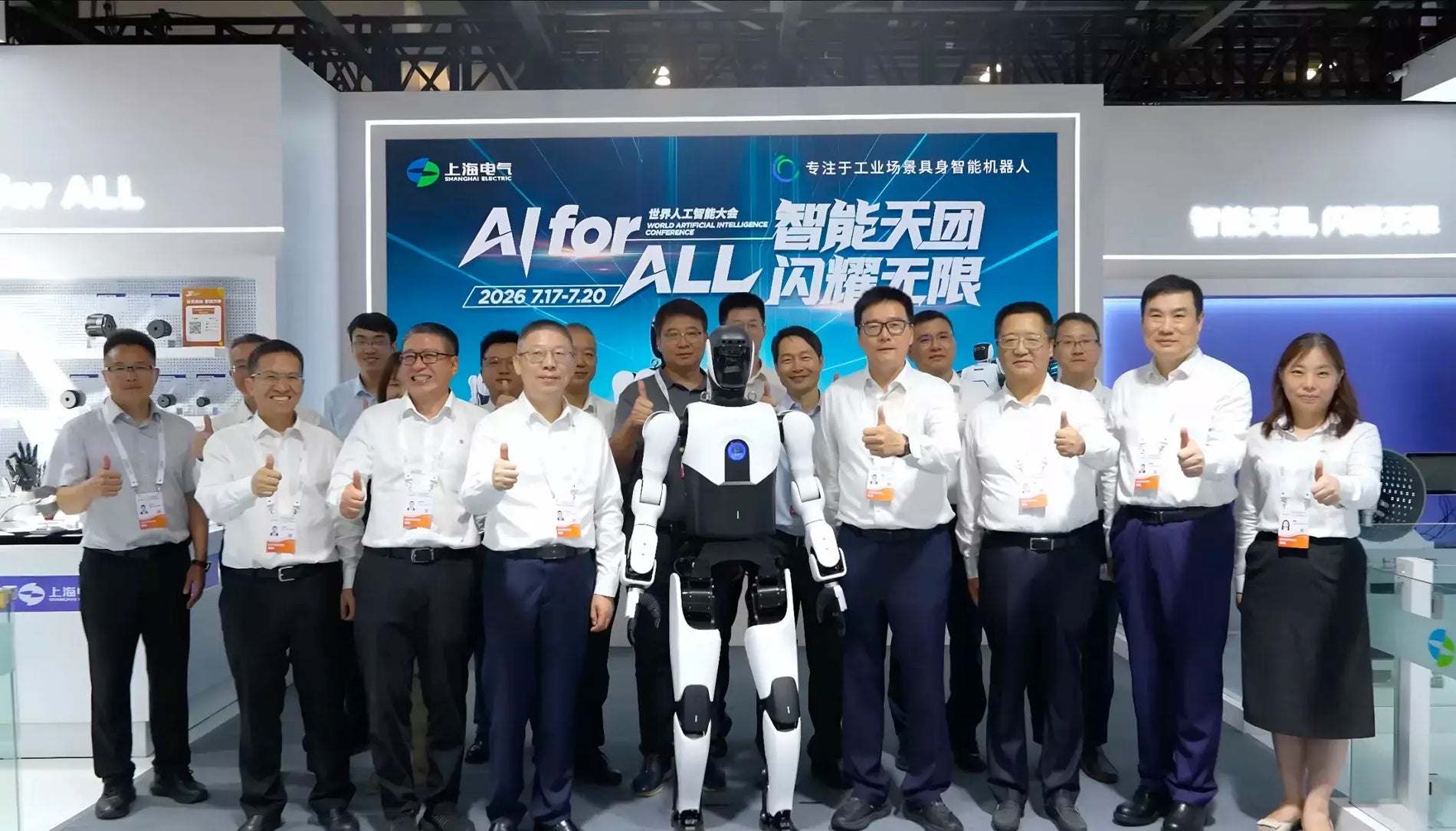
Industrial enterprises now look beyond traditional fixed-programmed machines to optimize shop floor productivity. Consequently, the race to integrate artificial intelligence into heavy industry has moved past standard standalone software. At WAIC 2026, Shanghai Electric unveiled a comprehensive suite of embodied AI robots, specialized industrial agents, and an AI-native factory architecture. This deployment marks a major shift toward autonomous physical systems that can perceive, decide, and execute tasks in complex production environments.
Overcoming Constrained Spaces in Industrial Automation
Traditional hardware setups often struggle with variable environments and confined machinery spaces. To solve this issue, the company developed an autonomous pipe inner-wall chamfering robot tailored specifically for narrow clearances. The system processes thousands of pipe hole edges while maintaining an impressive positioning accuracy within $\pm 1\text{ mm}$. Furthermore, it transmits critical operational data in real time to the central plant monitoring network. Therefore, this technology successfully merges robust mechanical execution with real-time data streaming to eliminate manual errors.
Deploying Intelligent Humanoids on the Factory Floor
Advanced manufacturing requires flexible hardware that can handle delicate electronic components and heavy physical parts. The system processes data dynamically: visual sensor data from the head passes through a multimodal perception layer, which then informs the embodied foundation model to drive the high-accuracy actuators.
Shanghai Electric addressed this need by showcasing its SUYUAN bipedal humanoid robot, which features 41 degrees of freedom and multimodal visual sensing. Additionally, a dual-battery hot-swap system allows the platform to operate continuously without shutdown constraints. For heavier floor operations, the TUOYUAN wheeled humanoid utilizes an embodied intelligence foundation model alongside force-position hybrid control. As a result, this machine seamlessly executes multi-specification connector insertions and automates the loading of automotive sheet metal components.
Upgrading Core Component Mechanics for Higher Forces
To support high-force applications, the engineering teams developed a specialized planetary roller screw component. This mechanical upgrade delivers more than three times the load capacity of conventional ball screws, making it ideal for the variable gripping and high-force manipulation required during connector insertion and wiring.
Expert Engineering Insight: Conventional ball screws often fail prematurely under high cyclic loads in automated assembly line applications. Upgrading to planetary roller screws provides the necessary mechanical resilience to sustain high force output without increasing the physical footprint of the joint actuator.
The company paired this high-capacity mechanical system with the DexHand, a highly flexible robotic hand designed for intricate manipulation. This combination allows the system to easily replicate human dexterity during complex wiring and sorting tasks. Consequently, these components provide the mechanical foundation required to support advanced cognitive AI models.
Integrating Enterprise Software with Edge Control Systems
True factory automation requires complete vertical integration between edge hardware and cloud-level enterprise assets. Shanghai Electric launched 51 industrial-grade AI models and agents under its StarCloud Intelligent Manufacturing platform. Instead of running as isolated IT applications, these agents embed directly into the local robotic decision-making loop. They digitize human manufacturing expertise into reusable, scalable code blocks. Accordingly, the platform automates complex production scheduling, runs real-time quality inspections, and triggers predictive maintenance alerts before component failures occur.
Constructing Closed-Loop Architecture for Smart Factories
Modern B2B facilities need a unified control architecture to break down stubborn data silos. The newly introduced AI-native framework vertically integrates manufacturing processes, industrial software, and intelligent equipment.
The architecture utilizes three distinct operational layers: an AI Factory Brain at the top for centralized optimization and DCS coordination, an Execution Network in the middle comprising embodied robots and AI agents for real-time actuation, and a Physical Twin at the base providing a continuous data mirror and telemetry loop. This structural configuration gives the facility self-perception and self-execution capabilities. Therefore, the plant transitions smoothly from old, experience-based operations to dynamic, data-driven optimization loops.
Technical Commentary on Embodied Industrial Intelligence
From a senior automation engineer's perspective, this release represents a crucial shift in the classic automation pyramid. Historically, engineers separated field-level machinery from upper-level DCS and PLC networks due to latency and data translation limits. Embedding foundation models directly into edge controllers allows physical robots to interpret dynamic environments natively. However, maintaining deterministic timing across these AI-driven networks remains a technical challenge. If Shanghai Electric successfully stabilizes these deterministic latency variables, this architecture will likely define the next decade of smart factory design.
B2B Application Scenario: Automotive Sub-Assembly Lines
A practical implementation scenario for this integrated technology is an automated automotive sub-assembly line. The TUOYUAN wheeled humanoid robot first fetches raw automotive sheet metal parts from delivery pallets. It then positions the metal precisely under a high-force press driven by the company's planetary roller screws. Simultaneously, the Mermaid bionic robot scans the control panel, adjusts field parameters, and activates the process.
Throughout the lifecycle, the StarCloud platform continuously monitors terminal telemetry data via industrial AI agents. If the system detects tool wear or alignment drift, the AI brain automatically recalculates the operational path. It pushes these updates to the edge devices without requiring any line stoppages or manual PLC reprogramming.