

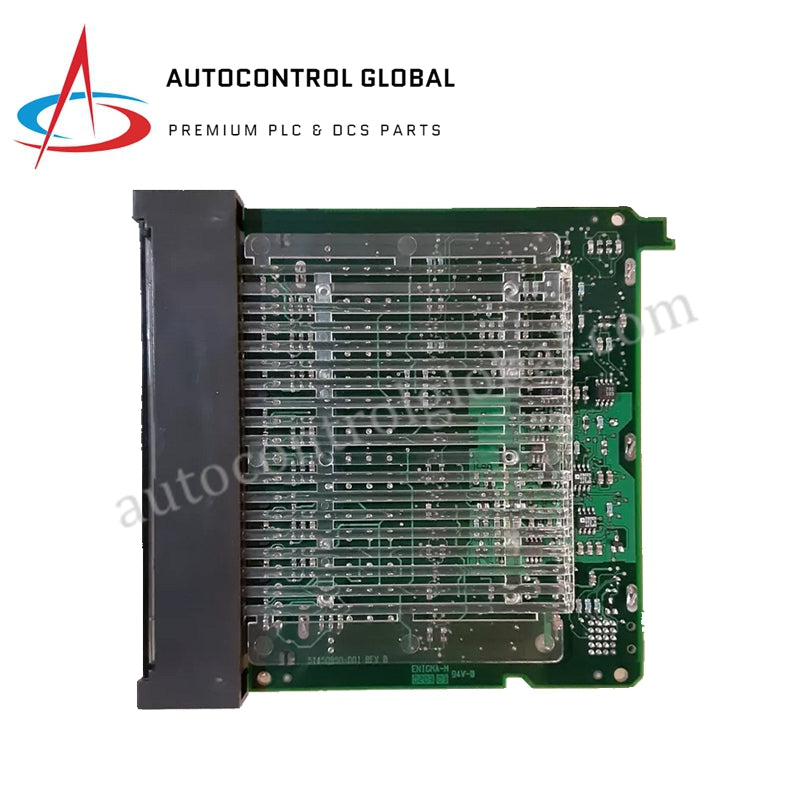
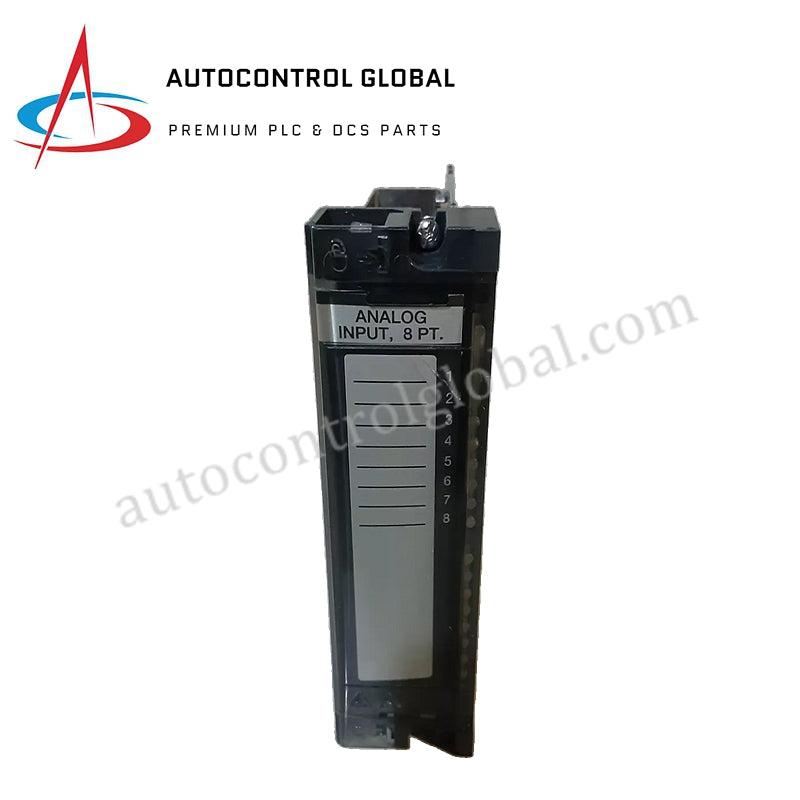


Honeywell HC900 900A01-0001 8-Channel Analog Input Module
Manufacturer: Honeywell
-
Part Number: 900A01-0001
Condition:New with Original Package
Product Type: Analog Input Module
-
Country of Origin: USA
Payment:T/T, Western Union
Shipping port: Xiamen
Warranty: 12 months
Honeywell 900A01-0001 HC900 Analog Input Module
The Honeywell 900A01-0001, also cataloged as the 900A01 Analog Input Module, operates as a dedicated hardware component for multi-range analog signal acquisition within Honeywell HC900 platforms. The hardware accepts 8 channels of independent current and voltage inputs, converting continuous physical loops into digitized values for internal controller synchronization. It executes constant parameter scanning across a high-performance bus architecture, enabling simultaneous processing of field instrumentation data frames over localized serial and network links.
Hardware Specifications
| Parameter | Specification |
|---|---|
| Model | 900A01-0001 |
| Brand | Honeywell |
| Origin | USA |
| Weight | 0.35 kg (0.77 lbs) |
| Dimensions | 120 x 70 x 40 mm (4.7 x 2.8 x 1.6 inches) |
| Operating Temp | -40 to +85 deg C |
| Power Consumption | 10 W maximum |
| Channels | 8 input channels |
| Input Signal Range | 0-20 mA, 1-5 VDC, 10-50 mV |
| Galvanic Isolation | Integrated on each channel |
| Communication Interface | RS-485, Ethernet |
| Enclosure Type | IP67 |
Process Control & DCS Instrumentation
The module architecture integrates robust galvanic isolation across every input node to isolate the 8 processing lines from electrical ground anomalies and differential field spikes. The input circuitry accommodates standard industrial 4-20 mA HART loop protocol parameters alongside low-voltage millivolt loops, employing a delta-sigma analog-to-digital converter matrix to lock signal accuracy down to sub-millivolt increments. Onboard digital filtering structures eliminate high-frequency interference induced by nearby motor switchgear, stabilizing the internal data register frames before exposing the values to the central HC900 processor core via deterministic Ethernet backplane sweeps.
Frequently Asked Questions
Q: How do technicians change individual channel ranges between 0-20 mA and 1-5 VDC loops?
A: Technicians manage individual channel scaling and range selections via the system software environment. The internal hardware matrix switches input impedance loads automatically based on the chosen register profile without requiring manual jumper configuration on the circuit board.
Q: Does the IP67 housing protect the interior electronic components from high moisture condensation?
A: Yes. The sealed IP67 mechanical structure prevents dust infiltration and resists water immersion up to standard test limits. This design permits localized deployment inside harsh process environments within the stated -40 to +85 deg C envelope.
Q: Can an engineer replace a faulty module without disrupting the active communication bus?
A: Redundant HC900 chassis configurations allow operators to remove and insert modules if the rack hardware documentation explicitly defines active hot-swap capability for that node slot. Check system bus load budgets before replacing modules to avoid unexpected voltage drops.
Field Installation Guidelines
Mount the module securely within the dedicated enclosure assembly, ensuring proper alignment of the interface seals to maintain the IP67 ingress rating. Tighten all compression fasteners to nominal specifications to ensure constant connection pressure against the mounting plate under mechanical vibration.
Electrostatic discharges degrade high-precision analog sub-assemblies. Engineers must wear a verified grounding wrist strap or maintain contact with a low-impedance grounding point throughout the handling and insertion procedure.
Terminate all 0-20 mA and voltage lines using twisted, shielded pair instrumentation wire. Ground the cable shields strictly at the marshaling cabinet end to prevent the creation of ground loop paths across the isolated channel interfaces. Route the RS-485 and Ethernet communication cables outside the high-voltage electrical raceways to isolate the low-voltage analog inputs from inductive noise corruption.